This directory covers 12 compute providers and their published credit, hardware, capacity, pricing, storage, network, support, SLA, and portability terms as checked on July 31, 2026.
1. Amazon Web Services (AWS)
-
Startup credits, discounts, and eligibility
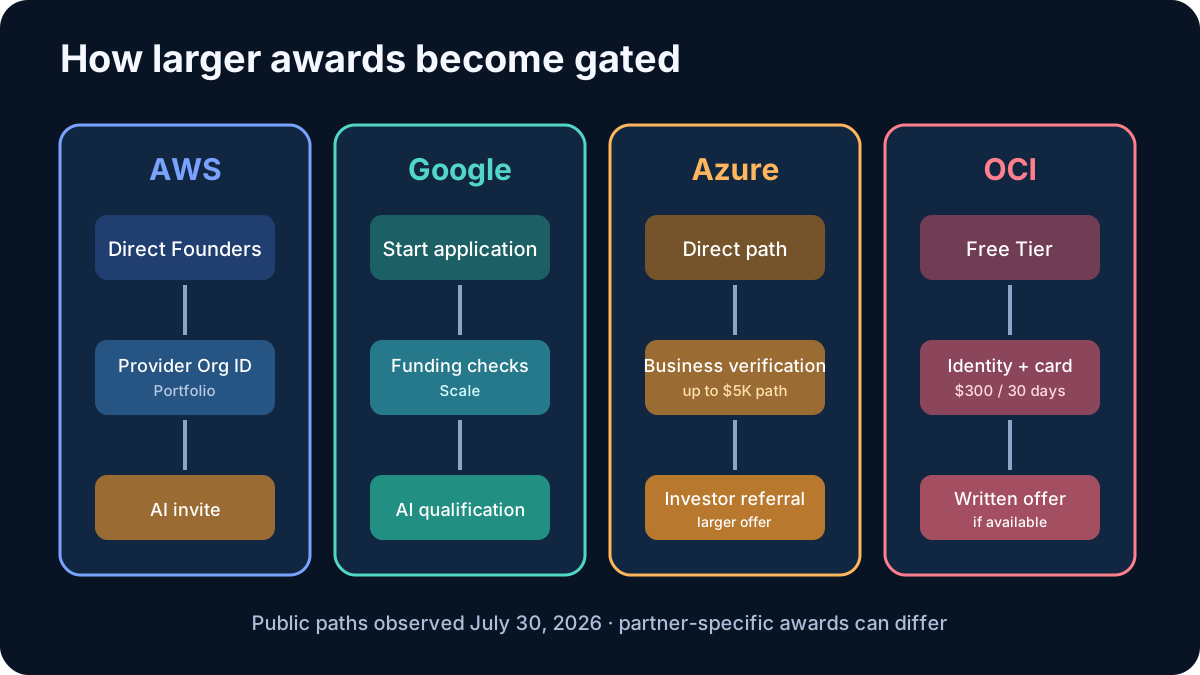
- AWS Activate Founders: The public entry path starts at $1,000 in AWS credits. Selected companies can receive up to $5,000.
- AWS Activate Portfolio: Companies associated with an approved AWS Activate Provider can apply with the provider’s Org ID. AWS advertises awards up to $100,000 on the standard program page and higher packages through selected programs. The exact award comes from AWS, not from the investor or accelerator.
- The public eligibility rules generally require a privately held, pre-Series B startup founded within the past 10 years. Previous AWS credit awards count toward lifetime limits.
- Credits normally cover eligible AWS service charges. Marketplace purchases, Professional Services, Training, Certification, Route 53 domain registration and transfer, cryptocurrency mining, and upfront Savings Plan or Reserved Instance fees are excluded unless written terms say otherwise.
- Compute discounts are separate from credits. Savings Plans discount eligible usage in exchange for a one- or three-year hourly-spend commitment. Reserved Instances can discount specific EC2 usage and may include a capacity reservation when scoped to an Availability Zone.
-
Machine and GPU catalog
- EC2 includes burstable, general-purpose, compute-optimized, memory-optimized, storage-optimized, HPC, accelerated, and bare-metal families. ARM-based Graviton and x86 choices let a team test price and portability separately.
- GPU families include G instances for graphics and inference and P instances for training and HPC. The current accelerated catalog includes NVIDIA T4, A10G, L4, L40S, H100, H200, and Blackwell systems. Exact models depend on region.
- SKUs include fractional, single-GPU, eight-GPU, and multi-node configurations. Eight separate one-GPU instances do not provide the same NVLink or fabric topology as one eight-GPU machine.
-
Regions, capacity, and quota constraints
- EC2 quotas are regional and split by purchase model and machine family. Default On-Demand quotas are zero vCPUs for many accelerated families, including P, G/VT, Inf, Trn, and DL.
- Spot quotas are separate and may also begin at zero. An approved quota only lets the account request capacity. It does not prove that the selected Availability Zone has free hosts.
- Capacity Reservations hold eligible EC2 capacity in one Availability Zone. Capacity Blocks for ML can reserve supported GPU capacity for a future window.
-
On-demand, reserved, and Spot pricing
- On-Demand pricing has no long contract. EC2 Linux usage is normally billed by the second with a 60-second minimum.
- Spot uses spare EC2 capacity at a discount. AWS can interrupt an instance and normally gives a two-minute warning. Checkpoint writes and replacement time are separately billed usage.
- AWS prices vary by region. The EC2 pricing page and calculator publish complete machine prices.
-
Storage, network, and egress
- EBS gp3 includes 3,000 IOPS and 125 MiB/s baseline performance. A published US-region example uses $0.08 per GB-month, $0.005 per extra IOPS-month, and a separate throughput charge above the baseline.
- AWS includes 100 GB per month of public data transfer across covered services. A US East EC2 example charges $0.09 per GB for the first 10 TB after the free amount.
- Cross-Availability-Zone EC2 traffic can cost $0.01 per GB in each direction. NAT Gateway processing and hourly charges can add another layer. Map the packet path before multiplying a single “egress” number.
-
Support, infrastructure, and SLA
- Business Support+ starts at the greater of $29 per account per month or a tiered percentage of monthly charges. AWS states an under-30-minute response target for a business-critical outage under that plan.
- EC2 service commitments depend on architecture. A multi-AZ deployment can qualify for a different SLA than one instance in one zone. Service credits are the remedy, require a claim, and do not repay business loss.
-
Exit costs and portability
- Eligible customers making a full exit can request data-transfer-out credits through Support. AWS says approved customers generally have 90 days to finish the move.
- The waiver does not erase S3 read requests, Glacier retrieval, database export compute, conversion, destination storage, dual running, staff time, retained backups, Marketplace terms, or unused commitments.
- Standard Linux VMs, OCI containers, Kubernetes, PostgreSQL, S3-compatible clients, and open model formats use third-party interfaces. DynamoDB, Lambda, IAM, and Trainium use AWS-specific APIs or software.
-
Primary sources
- AWS Activate credits and eligibility
- AWS promotional-credit terms and exclusions
- AWS accelerated-computing instances
- EC2 instance quotas
- EC2 On-Demand pricing
- EC2 Spot interruption behavior
- EBS pricing
- AWS data-transfer pricing
- AWS Support pricing and response targets
- Free transfer for a full AWS exit
2. Google Cloud
-
Startup credits, discounts, and eligibility
- Google for Startups Cloud Program, Start tier: Up to $2,000 for one year.
- Scale tier: Up to $200,000 over two years.
- Scale AI tier: Up to $350,000 over two years for qualifying AI-first startups.
- Scale year one covers 100% of eligible charges up to $100,000. Scale AI can cover up to $250,000 in year one. Year two covers 20% of eligible charges up to another $100,000. To use the full second-year award, a company must incur $500,000 of eligible second-year spend.
- Start requires a working MVP, a company founded within 24 months, plans to seek venture funding, and no prior Google Cloud credits beyond the free trial. Scale has company-age, funding-stage, and recent-round rules. Prior Google Cloud credits generally cannot exceed $5,000.
- The program excludes third-party models. Its benefit page names Google models such as Gemini and Gemma as covered. Marketplace and Vertex AI eligibility is product-specific.
-
Machine and GPU catalog
- Compute Engine offers shared-core, general-purpose, compute-optimized, memory-optimized, storage-optimized, and bare-metal families.
- Accelerator-optimized A-series machines include H100 and H200 configurations. Google also sells attachable GPUs and newer Blackwell systems where available.
- TPUs provide a Google accelerator path for JAX, TensorFlow, and supported PyTorch workflows, with added compiler and portability work.
-
Regions, capacity, and quota constraints
- A project can need both the global GPUs (all regions) quota and a quota for the exact GPU model in the exact region.
- Standard, Spot, workstation, reservation, and committed-use resources can use separate quota categories. Reservations consume quota.
- Quota approval does not allocate a host. Regional and zonal inventory still controls whether the VM starts.
-
On-demand, reserved, and Spot pricing
- Compute Engine On-Demand prices depend on machine family, region, operating system, accelerator, and attached services.
- Resource-based and spend-based Committed Use Discounts exchange a one- or three-year commitment for a lower eligible usage rate. Scope varies by resource and region.
- Spot VMs use spare capacity, can be preempted at any time, and have no availability guarantee. Google provides a best-effort shutdown notice of up to 30 seconds by default. A longer 120-second notice is available for supported Preview configurations.
-
Storage, network, and egress
- Balanced Persistent Disk in Iowa was listed at about $0.10 per GiB-month when checked. Hyperdisk can add charges for provisioned IOPS and throughput.
- Premium Tier public transfer varies by source and destination. Standard Tier uses separate rates. Google announced 200 GB free per region per month for eligible Standard Tier traffic.
- Cross-zone, cross-region, load-balancer, Cloud NAT, and inter-service transfer have path-specific rates in the VPC pricing table.
-
Support, infrastructure, and SLA
- Standard Support starts at the greater of $29 per month or 3% of monthly charges.
- Enhanced Support normally starts at $100 per month or a tiered percentage and lists a one-hour P1 response target. Scale startups can receive up to $12,000 of Enhanced Support credits for one year.
- Compute Engine SLA terms depend on whether the workload uses multiple zones. Credits require a claim and exclude several kinds of planned or customer-caused downtime.
-
Exit costs and portability
- Google’s full-exit program requires an Exit Notice and a billing support agent. It applies to a complete migration from the relevant service and ends with termination of the relevant service agreement.
- Source operations, Nearline or Archive retrieval, database export, conversion, destination storage, validation, dual running, staff time, and contract obligations remain.
- GKE workloads can export OCI container images and Kubernetes manifests. BigQuery, Spanner, Pub/Sub, Vertex endpoints, and TPU code use Google-specific APIs or runtimes.
-
Primary sources
3. Microsoft Azure
-
Startup credits, discounts, and eligibility
- Direct startup path: $1,000 for 90 days, then $4,000 for 180 days after business verification.
- Investor offer: Most accepted companies begin with $100,000 and may earn more. It requires a referral code from a participating investor, accelerator, incubator, angel network, university, or similar group.
- The company must be privately held, for profit, own a software product or service, operate where Azure is available, have no more than $350,000 in lifetime free Azure credits, and have no Series C or later funding.
- Non-Azure products, paid support plans, Marketplace purchases, and partner-billed models may fall outside coverage. Credits do not make every model in Microsoft Foundry free.
- Startup subscriptions move to usage-based billing after credits end. Azure budgets and cost alerts are separate account features.
-
Machine and GPU catalog
- Azure has general-purpose, compute-optimized, memory-optimized, storage-optimized, confidential, HPC, and GPU VM families.
- NC families serve GPU compute and visualization. ND families target large-memory AI training. NV families target visualization and virtual workstations.
- Azure size pages list GPU count, GPU memory, NVLink or InfiniBand, local NVMe, vCPU, RAM, and supported images for each VM.
-
Regions, capacity, and quota constraints
- A launch must fit both the total regional vCPU quota and the VM-family vCPU quota.
- Standard and Spot VMs use separate quota pools. New subscriptions often have zero quota for scarce GPU families.
- Quota approval does not reserve physical capacity. Capacity Reservations can improve certainty for supported sizes but add region and term constraints.
-
On-demand, reserved, and Spot pricing
- Usage-based prices vary by region, operating system, license, and VM size. Azure publishes complete machine rates through its calculator.
- Spot VMs have variable discounts and can be evicted when Azure needs capacity or when the market price crosses the configured maximum. Azure gives a best-effort scheduled event of up to 30 seconds.
- Spot VMs have no SLA and no automatic restart. The eviction policy deletes or deallocates the VM. Deallocation can leave disks and addresses billing.
-
Storage, network, and egress
- Several Managed Disk types use provisioned size tiers. A 130 GiB disk may bill at the next tier instead of at exactly 130 GiB.
- Azure includes the first 100 GB per month of public egress. The Premium Global Network table checked on July 31, 2026 listed $0.087 per GB for the next 10 TB from North America and Europe.
- Zone-to-zone, region-to-region, peering, NAT Gateway, load balancer, public IP, and firewall charges need separate rows in the model.
-
Support, infrastructure, and SLA
- Public prices list Developer at $29 per month, Standard at $100, and Professional Direct at $1,000.
- The investor startup offer includes Azure Standard Support. Offers of at least $5,000 also include Azure advisory pairing sessions.
- VM SLAs depend on the VM and deployment pattern. Availability Zones and availability sets have separate commitments in the service agreement.
-
Exit costs and portability
- Azure’s full-exit procedure requires a support request with subscription IDs, start date, and estimated transfer amount. The standard window is 60 days; longer requested windows must appear in the initial case.
- The waiver does not remove source reads, destination services, conversion, validation, dual running, staff time, commitments, backup retention, or traffic outside the approved transfer.
- VMs, containers, AKS, PostgreSQL, and open model formats have standard export interfaces. Entra identity, Cosmos DB, Service Bus, Functions bindings, and managed AI endpoints use Azure-specific APIs.
-
Primary sources
- Microsoft for Startups FAQ
- Microsoft for Startups eligibility overview
- Using Azure startup credits
- Foundry model credit coverage
- Azure VM and GPU size catalog
- Azure regional quota requests
- Azure Managed Disks pricing
- Azure bandwidth pricing
- Azure support plans
- Azure Spot VM behavior
- Azure free-exit procedure
4. Oracle Cloud Infrastructure (OCI)
-
Startup credits, discounts, and eligibility
- OCI Free Tier: $300 for up to 30 days, plus eligible Always Free resources.
- Oracle’s current public startup page points companies to Free Tier and does not state a larger standard startup award.
- Older Oracle startup pages described $500 in credits, a 70% discount, and Credits to Scale. Those terms are not publicly listed on the current program page.
- Universal Credits and annual-flex contracts can discount committed use. These are negotiated commercial contracts, not a public startup grant.
-
Machine and GPU catalog
- OCI Flex shapes let a customer select CPU and memory in smaller increments than fixed VM catalogs.
- The compute catalog includes A10-based GPU VMs and CPU shapes based on AMD, Intel, and Ampere ARM processors.
- Bare-metal GPU options include A100, H100, H200, L40S, MI300X, MI355X, B200, B300, GB200, GB300, and RTX Pro configurations where available.
- Many accelerator shapes allocate a full eight-GPU bare-metal node, so the minimum allocation is eight GPUs.
-
Regions, capacity, and quota constraints
- OCI publishes service limits by region, availability domain, and tenancy. Many GPU limits begin at zero for trial and usage-based accounts.
- A limit increase does not guarantee a host. Oracle may require sales approval or a capacity reservation for a large GPU request.
- Capacity depends on shape, GPU count, tenancy limit, subscription type, region, availability domain, and cluster-network requirements.
-
On-demand, reserved, and preemptible pricing
- OCI uses usage-based and committed contract pricing. Taxes and special-region rates are separate from standard public list prices.
- Preemptible instances are short-lived discounted capacity. Oracle sends an event two minutes before termination. The instance then terminates and cannot be stopped, started, or rebooted.
- Bare-metal GPU pricing covers the whole server and all GPUs in the selected shape.
-
Storage, network, and egress
- OCI Block Volume prices capacity separately from Volume Performance Units. A disk quote without the VPU setting is incomplete.
- OCI includes the first 10 TB per month of public internet egress.
- OCI states that intra-region data movement is free. Cross-region, FastConnect provider, public IP, load balancer, and security service costs still require checking.
-
Support, infrastructure, and SLA
- Oracle states that paid OCI service fees include enterprise-level infrastructure support and 24/7 infrastructure support.
- Free Tier uses community support. Trial accounts receive limited support until the trial ends.
- OCI publishes service-level agreements, objectives, and indicators that vary by product and architecture.
-
Exit costs and portability
- The 10 TB monthly public-egress allowance can cover a smaller exit without a special waiver.
- Traffic above the allowance, source reads, Archive retrieval, object requests, and database export retain their standard charges.
- Flex shapes use standard VM images and containers use OCI formats. Oracle Database, Autonomous Database, OCI IAM, and OCI networking use Oracle-specific formats or APIs.
-
Primary sources
5. CoreWeave
-
Startup credits, discounts, and eligibility
- A standing self-serve startup credit amount and general eligibility table are not publicly listed.
- CoreWeave offers four capacity plans: On-Demand, Spot, Reserved Instances, and Flex Reservations. Reserved and Flex capacity are negotiated commercial discounts rather than public startup grants.
-
Machine and GPU catalog
- Current platform pricing lists eight-GPU NVIDIA HGX B200, H200, and H100 systems, RTX Pro 6000 Blackwell Server Edition nodes, and one-GPU GH200 instances. Regional catalogs also include L40, L40S, and A100 systems.
- Posted eight-GPU node prices include the listed CPU, RAM, local NVMe, and network capacity.
- HGX H100 and H200 clusters use NVIDIA Quantum-2 InfiniBand. The current product page describes up to 3.2 Tbps per H100 node.
-
Regions, capacity, and quota constraints
- CoreWeave divides infrastructure into geographies, super regions, regions, and availability zones. Some zones are General Access and some are Dedicated Access for selected customers.
- GPU types differ by zone. For example, current US East tables list GB200 and H200 in one New Jersey zone and H200, H100, RTX Pro 6000, L40S, L40, GH200, and A100 in a Virginia zone.
- On-Demand and Spot have no capacity guarantee. Reserved Instances and Flex Reservations do.
-
On-demand, reserved, and Spot pricing
- The public page checked July 31, 2026 listed an eight-GPU B200 node at $68.80 per hour On-Demand and $34.11 Spot, an eight-GPU H200 node at $50.44 and $20.93 Spot, and an eight-GPU H100 node at $49.24 and $19.71 Spot.
- It listed a one-GPU GH200 instance at $6.50 per hour with no public Spot rate.
- Reserved and Flex rates are contract-specific. Unused reserved capacity does not become free. Flex holding charges continue even when nodes are idle.
-
Storage, network, and egress
- CoreWeave offers local NVMe, distributed file storage, and AI Object Storage. Object data automatically moves among hot, warm, and cold billing tiers based on recent access.
- Current docs say regions have free inter-region data transfer, 200 Gbps or faster public connectivity, and a private 400 Gbps or faster backbone.
- CoreWeave product pages list zero ingress and egress fees for storage offerings. Contract scope can vary by product, direction, region, public path, and Direct Connect use.
-
Support, infrastructure, and SLA
- CoreWeave operates the Kubernetes control plane, node operating system, drivers, health checks, network layer, and physical infrastructure under its shared-responsibility model.
- Product material describes 24/7 support. Public marketing cites 99.9% or higher SLAs for covered enterprise deployments, but the binding order and SLA control.
- The customer still owns data classification, backup, disaster recovery, IAM policy definitions, application security, and application reliability.
-
Exit costs and portability
- Zero-transfer terms apply only to covered storage and network paths.
- Costs remain for object reads, filesystem staging, database services on another cloud, conversion, destination storage, dual running, validation, and engineering.
- Kubernetes, containers, S3-compatible object access, Slurm, and standard NVIDIA software provide documented export or redeployment paths.
- Regional filesystems, local NVMe, CKS objects, CoreWeave IAM, Direct Connect, and capacity contracts use CoreWeave-specific configuration or terms.
-
Primary sources
6. Lambda
-
Startup credits, discounts, and eligibility
- Lambda advertises cloud credits for companies in NVIDIA Inception and NVIDIA Connect. Its current Blackwell program page states a $7,500 offer for eligible member companies.
- Lambda also advertises compute credits for Y Combinator companies. The public page tells eligible YC companies to apply but does not state a fixed award.
- Coverage across On-Demand instances, serverless inference, filesystems, and 1-Click Clusters is not publicly listed for every offer. Expiration and regional terms are offer-specific.
-
Machine and GPU catalog
- On-Demand Cloud offers one- to eight-GPU Linux VMs. The current catalog includes B200, GH200, H100 SXM, H100 PCIe, A100 SXM and PCIe, A10, A6000, V100, and RTX 6000 configurations.
- The one-GPU B200 shape lists 180 GB of GPU memory, 26 vCPUs, 360 GiB of RAM, and a 2.75 TiB root volume. The eight-GPU shape lists 208 vCPUs, 2,900 GiB of RAM, and 22 TiB of root storage.
- 1-Click Clusters cover 16 to 512 B200 or H100 GPUs in current documentation. Larger private and hyperscale contracts extend into thousands of GPUs.
-
Regions, capacity, and quota constraints
- Lambda lists regions in Japan, India, Germany, Israel, Virginia, Washington DC, Illinois, several Texas sites, California, Arizona, and Utah.
- Not every machine type is available in every region. The console is the current source for launchable inventory.
- On-Demand does not reserve future capacity. Terminating a scarce instance can mean it is unavailable when the team returns.
- Filesystems are regional and must be attached when the instance or cluster launches. They cannot currently be moved between regions.
-
On-demand, reserved, and interruption pricing
- Lambda bills On-Demand instances by hourly price in one-minute increments. Billing begins after the instance passes health checks and ends when it is terminated.
- 1-Click Clusters are priced per GPU-hour and billed in weekly increments under the reservation.
- A general self-serve Spot market is not publicly listed for Lambda GPU instances.
-
Storage, network, and egress
- Regional filesystems are billed per GiB used per month in one-hour increments. The console shows the current rate at creation.
- Billing continues while a filesystem exists. Most regions document an 8 EB ceiling and 24-filesystem account limit; Texas
us-south-1has a 10 TB limit. - Lambda lists no filesystem ingress or egress charge. Other internet transfer paths are not addressed on the filesystem billing page.
- Filesystems cannot be attached to a running instance and cannot be mounted remotely by NFS. The S3 adapter is available only in selected regions;
rsyncis the fallback.
-
Support, infrastructure, and SLA
- Lambda documents support for 1-Click Clusters with incident levels and initial-response targets. The exact SLA depends on the contracted product.
- Private Cloud includes 24/7 hardware support. Managed Kubernetes, preinstalled Kubernetes, and Slurm are available for cluster products.
- Lambda’s narrow AI focus can give customers direct access to ML engineers, but it does not replace the breadth of a hyperscaler’s database and application catalog.
-
Exit costs and portability
- Ubuntu, SSH, Docker, PyTorch, CUDA, Kubernetes, Slurm, and ordinary model files use standard third-party interfaces.
- A regional filesystem exit may need an instance in the same region to stage and transmit data.
- No egress fee still leaves source reads, staging compute, destination storage, checksum runs, database moves, dual operation, and staff time.
-
Primary sources
7. Crusoe Cloud
-
Startup credits, discounts, and eligibility
- Crusoe does not publish a standing startup-credit amount or a general eligibility schedule on its current pricing and documentation pages.
- The public commercial choices are On-Demand, Spot, and reserved agreements. Reserved pricing requires a fixed quantity, product line, period, unit price, and sometimes a location constraint.
- Unused reserved capacity does not roll over. Usage above the reservation at any moment is charged On-Demand or at the negotiated overage rate, even if the customer was below the reservation earlier that month.
-
Machine and GPU catalog
- Current GPU VMs include NVIDIA GB200, B300, B200, H200, H100, A100, and L40S, plus AMD MI300X and MI355X in supported zones.
- The public price page lists one-GPU equivalents. VM specifications separately list GPU count, vCPU, RAM, local disk, VPC bandwidth, InfiniBand or RoCE, and zone.
- A current eight-GPU MI355X shape includes 288 GB per GPU and 3,200 Gbps accelerator networking. A B300 shape is listed in Iceland with 6,400 Gbps InfiniBand.
-
Regions, capacity, and quota constraints
- VM types are zone-specific. Some are restricted and require sales approval before immediate provisioning.
- Project quotas cover GPU and CPU instances, disks, networking, and managed services. Organization quotas cover projects and users.
- Crusoe explicitly states that quota is not reserved capacity. If a launch fails below quota, the zone may be out of the resource.
-
On-demand, reserved, and Spot pricing
- The public page checked July 31, 2026 listed H200 at $4.29 per GPU-hour, H100 at $3.90, A100 80 GB SXM at $2.30, A100 80 GB PCIe at $2.00, L40S at $1.50, and MI300X at $3.45 On-Demand.
- Public reserved examples for H200 show $3.43 for six months, $3.22 for one year, and $2.79 for three years per GPU-hour. Included host resources appear in the VM specifications.
- Spot prices are current-market prices and require sales contact for some GPUs. Spot instances can stop and restart.
-
Storage, network, and egress
- Public storage prices list persistent disks at $0.08 per GiB-month, shared disks at $0.07, object storage at $0.06, and container registry at $0.10.
- Ephemeral disk is included with eligible VMs but is erased by a stop, restart, host reboot, or failure. It is scratch space, even when an application stripes it.
- Persistent and shared disks bill for provisioned capacity whether attached to a running VM or not.
-
Support, infrastructure, and SLA
- The current GPU VM SLA lists a 99.5% monthly service objective for one covered GPU-enabled VM.
- Basic support is included and uses best-effort response. Enterprise support is included for qualifying annual commitments or reservations and lists a one-hour 24/7 P1 target.
- Managed Kubernetes support covers the control plane, node OS, GPU drivers, Cilium, persistent disks, and cluster metrics. Customer-installed components and workloads remain customer-owned or best effort.
-
Exit costs and portability
- Containers, Linux VMs, Kubernetes, Slurm, S3-compatible object access, and raw model weights use standard third-party interfaces.
- Regional object storage and disks require a staged copy. Ephemeral local data disappears when the VM stops.
- Public transfer rates are location-specific. Disk reads and object operations retain their standard charges.
-
Primary sources
8. Nebius AI Cloud
-
Startup credits, discounts, and eligibility
- Nebius runs targeted credit programs rather than one permanent public startup tier.
- The 2026 AI Discovery Awards offered $100,000, $50,000, and $30,000 in GPU cloud credits to three winners. Applicants needed a legal entity, working website, MVP, go-to-market plan, an AI product in specified health fields, and a stage from pre-seed through Series D.
- Nebius supports promo codes and negotiated Committed Usage Discounts. Capacity block groups reserve GPUs and require a manager, contract addendum, quantity, region, GPU platform, and interval.
-
Machine and GPU catalog
- Current platforms include NVIDIA B300, B200, H200, H100, RTX Pro 6000, and L40S across public and private regions.
- In March 2026 Nebius added a public single-GPU B200 preset in addition to an eight-GPU configuration. H100 and H200 configurations use NVLink within supported hosts.
-
Regions, capacity, and quota constraints
- Public regions are Finland (
eu-north1), France (eu-west1), Israel (me-west1), and Kansas City (us-central1). Iceland and the United Kingdom are listed as private regions for customers with deployments there. - GPU types differ sharply by region. H100 is listed only in Finland. H200 appears in Finland, France, Kansas City, and the private Iceland region. B200 appears in Israel and Kansas City.
- Default quotas vary by GPU and region. The current table lists zero regular H200 quota in Kansas City and nonzero limits in several European regions.
- A capacity advisor combines quota and physical supply into low, medium, high, or limit-reached availability.
- Reservations hold GPUs even while the VM is stopped and do not count against ordinary GPU quota.
- Public regions are Finland (
-
On-demand, reserved, and preemptible pricing
- Nebius bills running GPU VMs by the second and publishes prices by GPU-hour. Stopped VM compute is free, but attached storage continues billing.
- Current unified pricing lists H100 at $2.95 per GPU-hour On-Demand and $1.25 preemptible. H200 is $3.50 and $1.45 preemptible.
- Preemptible machines are supported across the listed GPU platforms. They do not support reservations.
- Commitment discounts and capacity block prices are contract-specific. Unused committed intervals remain billable under the contract.
-
Storage, network, and egress
- Network SSD is listed at $0.071 per GiB-month, non-replicated SSD at $0.053, high-performance SSD IO M3 at $0.118, and shared SSD filesystem at $0.08.
- Object Storage and shared filesystem are separate products with class, operation, lifecycle, transfer, and throughput terms.
- The compute pricing page does not list one rate for every public and inter-region path. Network rates vary by destination.
-
Support, infrastructure, and SLA
- Nebius publishes a legal SLA with service-specific uptime levels and compensation schedules for paid services.
- Support is available through the console. Customers with account managers can receive a dedicated Slack support path.
-
Exit costs and portability
- VMs, containers, Kubernetes, Slurm, Terraform, S3-compatible object storage, and open weights use standard third-party interfaces.
- Capacity blocks and commitment discounts can continue billing after compute moves. Auto-renewal, platform substitution, and region changes are contract terms.
- Object operations, disk reads, and public transfer retain their published or contracted charges during export.
-
Primary sources
9. RunPod
-
Startup credits, discounts, and eligibility
- Starter tier: $1,000 in free credits for earlier-stage startups with real AI workloads and a near-term path to scale. RunPod describes the tier as intended for pre-Series A companies.
- Growth tier: A startup prepays $50,000 and receives $25,000 in bonus credits, for $75,000 total under a 12-month agreement.
- RunPod looks for working production inference, training, fine-tuning, or R&D with a production path; investor validation; immediate need; and new customers. Existing customers must contact their account manager.
- Savings Plans prepay three or six months of one GPU type. They cover GPU compute only, not storage, are nonrefundable, and expire on a fixed date.
-
Machine and GPU catalog
- RunPod lists more than 30 GPU models across Secure Cloud and Community Cloud. The current table includes B300, B200, H200, H100, RTX Pro 6000, A100, L40S, RTX 6000 Ada, A6000, A5000, A4000, 5090, 4090, 3090, and older cards.
- Instant Clusters join multiple nodes over 1,600 to 3,200 Gbps InfiniBand or RoCE v2. Public self-service access starts at two nodes and can expand after a spending-limit request.
-
Regions, capacity, and quota constraints
- RunPod advertises more than 30 regions, but each GPU, storage type, and cloud class has a different location set.
- The default account spending limit is $80 per hour. Larger instant clusters require an increase.
- A network volume is tied to a data center. Attaching it constrains Serverless workers or Pods to that location and can reduce GPU availability and failover options.
-
On-demand, reserved, and interruptible pricing
- Pods are billed by the second. On-Demand has no term and the resources cannot be displaced by other users.
- The public table checked July 31, 2026 listed Secure Cloud examples of $7.39 per hour for B300, $5.89 for B200, $4.39 for H200, and $1.99 for RTX Pro 6000. Rates vary by cloud class and host configuration.
- The account must hold at least one hour of credit for the selected On-Demand configuration.
-
Storage, network, and egress
- Running container disk costs $0.10 per GB-month and is erased when the Pod stops.
- Volume disk costs $0.10 while running and $0.20 while the Pod is stopped. It persists until the Pod is deleted but is tied to that host.
- Network volume costs $0.07 per GB-month below 1 TB and $0.05 above 1 TB. Current documentation warns that it is region-bound and may be deleted if the account cannot pay storage charges.
- RunPod lists no ingress or egress fees for Pods. Separate universal rates for Serverless, public endpoints, private networking, and managed clusters are not publicly listed on the Pod pricing page.
-
Support, infrastructure, and SLA
- Startup Starter includes direct support. Growth includes a 30-minute onboarding call and an enterprise path.
- Reserved Clusters offer SLA-backed uptime and dedicated support. The same terms are not publicly listed for self-serve Pods.
- RunPod stops workloads when the account lacks the required credit balance. Customer-managed backups and checkpoints are outside the platform SLA.
-
Exit costs and portability
- Pods have no listed egress fee. Host-bound volume disks and regional network volumes require data staging before a location change.
- Container images, Docker, SSH, REST APIs, ordinary model files, and Kubernetes-style clusters provide documented export and redeployment interfaces.
- Data access can stop when the account balance reaches zero. Weights, datasets, and container digests can be copied through standard filesystem and container interfaces.
-
Primary sources
10. Vultr
-
Startup credits, discounts, and eligibility
- The Vultr Digital Start-up Program advertises up to $100,000 in cloud credits and up to 35% long-term discounts.
- Eligibility requires recent Series A, B, C, D, or E financing. Applicants must provide the senior technical executive, the senior cloud-infrastructure leader, six months of cloud compute invoices, and agreement to be publicly referenceable.
- New-account trial credits can last up to 30 days and are separate from the startup program.
- Product coverage, account scope, and expiration vary by award. Coverage of a specific Cloud GPU or Bare Metal GPU product is not publicly listed for every award.
-
Machine and GPU catalog
- Vultr sells ordinary Cloud Compute, optimized CPU instances, bare metal, Kubernetes, object storage, databases, and Cloud GPU.
- GPU options include NVIDIA A100 PCIe and SXM, L40S, H100, GH200, HGX B200, and AMD MI300X and MI355X.
-
Regions, capacity, and quota constraints
- Vultr operates 33 cloud data-center regions, but GPU products are not present in every region.
- The region API and console expose current product availability. GPU models differ across the 33 regions.
- Quota, payment verification, and inventory are separate gates. A funded account can still lack the target GPU.
- Cloud GPU instances cannot change GPU device type after deployment. The documented path is to create another machine and migrate.
-
On-demand, reserved, and interruption pricing
- Vultr bills GPU servers hourly up to a 730-hour monthly cap. The minimum billing unit is one hour.
- Billing starts at deployment, continues while the machine is powered off, and ends when the instance is destroyed.
- A general Spot GPU market and public interruptible GPU discount are not publicly listed.
-
Storage, network, and egress
- Many VM plans include local storage and a transfer allowance. Additional Block Storage and Object Storage are separately billed.
- Vultr announced 2 TB of free outbound transfer per account each month, free ingress, global pooling of plan allowances, and $0.01 per GB overage. GPU-plan inclusion is plan-specific.
- Snapshots, automatic backups, load balancers, reserved IPs, DDoS options, and managed databases add charges.
-
Support, infrastructure, and SLA
- Startup-program benefits include priority support, architecture reviews, dedicated management, and executive sponsorship.
- Vultr publishes a 100% uptime SLA covering network and host-node availability, with service credits as the remedy and detailed exclusions.
- The 100% SLA applies only to the network and host-node events, conditions, and exclusions defined in the current legal terms.
-
Exit costs and portability
- Free ingress, pooled transfer, and the published overage rate apply under the plan’s transfer terms.
- Source reads, snapshots, object restoration, destination storage, database export, validation, dual running, and engineering remain.
- Standard Linux VMs, Docker, Kubernetes, Terraform, S3-compatible object clients, CUDA, and ROCm provide export and redeployment interfaces.
- Destroying a VM stops billing and removes local data. Stopping the machine does not stop billing.
-
Primary sources
11. DigitalOcean Paperspace
-
Startup credits, discounts, and eligibility
- DigitalOcean’s startup program advertises up to $100,000 in credits for qualified participants, normally through an approved startup-program partner.
- The program requires a new DigitalOcean team account created with a corporate-domain email address and valid card. The award level is set in the onboarding email.
- DigitalOcean separates core credits from GPU credits. As of May 13, 2026, core credits exclude GPU Droplets, H100 Kubernetes, Bare Metal GPUs, Dedicated and Serverless Inference, certain third-party models, and Paperspace Machines.
- Paperspace Gradient subscriptions provide access to selected free notebook machines under plan limits. They are not a substitute for production capacity.
-
Machine and GPU catalog
- Paperspace Machines include CPU VMs and NVIDIA M4000, P4000, P5000, P6000, RTX4000, RTX5000, A4000, A5000, A6000, V100, A100 40 GB, A100 80 GB, and H100 machines.
- Current machine specifications list H100 with 80 GB HBM3, 20 vCPUs, and 250 GB CPU RAM per GPU configuration unit.
-
Regions, capacity, and quota constraints
- Paperspace has historically exposed East Coast, West Coast, and Amsterdam machine regions. New GPU families may be available in only a subset.
- The API provides a machine-type availability check. A false response means the requested dedicated GPU is not currently available in that region.
- Shared drives, private networks, templates, and GPU types have separate regional availability.
-
On-demand, reserved, and interruption pricing
- Paperspace bills resources hourly. Compute billing stops when a Paperspace Machine is shut down, unlike a DigitalOcean Droplet, but attached storage, public IPs, and add-ons continue billing.
- The documentation checked July 31, 2026 lists M4000 at $0.45 per hour, A4000 at $0.76, A6000 at $1.89, V100 at $2.30, A100 at $3.09, A100 80 GB at $3.18, and H100 at $5.95.
- The same table lists eight H100s at $47.60 per hour and eight A100 80 GB GPUs at $25.44.
- A general Spot VM option is not publicly listed on the current Machines pricing table.
-
Storage, network, and egress
- Block Storage ranges from $5 per month for 50 GB to $55 for 1 TB in the current table. Larger tiers are also listed.
- Shared Drives cost $16 per month for 250 GB, $65 for 1 TB, and scale to larger fixed tiers.
- Paperspace states that it does not charge ingress or egress bandwidth for Machines.
- Public IP, private network, and VPN have hourly charges with monthly caps. Their billing continues independently of VM power state.
-
Support, infrastructure, and SLA
- DigitalOcean offers free general support and paid support plans. Startup packages can include Premium Support.
- Paperspace provides console, API, CLI, templates, private networking, shared storage, Gradient, and DigitalOcean account integration.
- A Paperspace Machine SLA is not publicly listed on the current Paperspace pricing page. DigitalOcean Droplet SLA terms name a different product.
-
Exit costs and portability
- Paperspace lists no Machine ingress or egress bandwidth charge.
- Storage, snapshots, templates, destination storage, database migration, validation, dual running, and staff time remain.
- SSH-accessible Linux machines, containers, Jupyter, standard CUDA frameworks, and ordinary model files provide export interfaces.
- Compute, storage, snapshots, templates, IPs, networks, and subscriptions have separate deletion and billing lifecycles.
-
Primary sources
12. DataCrunch
-
Startup credits, discounts, and eligibility
- A standing startup-credit award and general startup eligibility table are not publicly listed.
- Public discounts come through dynamic pricing, Spot, six-month contracts, and two-year contracts.
- Dynamic prices adjust daily with demand. A fixed-price deployment keeps its displayed price under the stated product rule.
-
Machine and GPU catalog
- The current catalog includes NVIDIA B200, H200, H100, A100, L40S, A6000, A5000, RTX 4090, and other generations. Current API material also lists RTX Pro 6000.
- H200 is available in one-, two-, four-, and eight-GPU virtual dedicated servers. Instant Clusters cover 16 to 64 GPUs, with larger bare-metal clusters sold through sales.
- The eight-H200 cluster specification lists 1,128 GB total GPU memory, 3,200 Gbit/s InfiniBand, 100 Gbit/s Ethernet, and local NVMe.
-
Regions, capacity, and quota constraints
- DataCrunch’s public API returns availability by location code. Current examples use Finland, while product pages refer more broadly to European and other locations.
- Dynamic and Spot supply can disappear. Long-term and bare-metal cluster orders provide more predictable capacity but need a delivery agreement.
- Regional storage and cluster fabric are location-bound. External checkpoint copies use separately billed storage or transfer paths.
-
On-demand, reserved, and Spot pricing
- The current H200 page lists $2.14 per hour On-Demand, $2.05 under six months, $1.60 under two years, and a $0.98 Spot example for one H200 in European locations.
- The B200 page lists $4.49 On-Demand for one B200, $4.31 at six months, and $3.37 at two years. An eight-B200 node is eight times those displayed rates.
- Prices can differ by location and change. Dynamic pricing updates daily. Fixed On-Demand prices remain fixed after deployment under the page’s note.
-
Storage, network, and egress
- Current public storage tables list NVMe block and shared storage at $0.20 per GB-month and HDD at $0.05.
- Local NVMe on GPU hosts is ephemeral. Persistent block and shared storage survive the instance lifecycle under their product terms.
- Public product pages show internal fabric and uplink specifications for clusters, but do not present one universal public-internet egress price for every location and product.
- A universal public rate for ingress, egress, cross-location traffic, public IPv4, DDoS, private connect, and storage requests is not publicly listed.
-
Support, infrastructure, and SLA
- Public product pages advertise expert support. A binding public SLA, support hours, priority levels, and response targets are not publicly listed for every product.
- API and SDK support cover VM and cluster automation. Images and startup scripts cover instance initialization.
-
Exit costs and portability
- Standard Linux VMs, SSH, containers, CUDA or ROCm, Slurm-style clusters, ordinary weights, and a documented REST API provide export and redeployment interfaces.
- Long-term rates remain billable under their contract. Dynamic and Spot capacity can become unavailable.
- Source disk reads and public transfer retain their published or contracted charges during export.
- Persistent-volume deletion is separate from instance deletion. Destination validation is customer-managed.
-
Primary sources